
2025
Tracking Dynamics of Supported Indium Oxide Catalysts in CO2 Hydrogenation to Methanol by In Situ TEM
Henrik Eliasson, Yung-Tai Chiang, Thaylan Pinheiro Araújo, Xiansheng Li, Rolf Erni, Sharon Mitchell, Javier Pérez-Ramírez
Advanced Materials
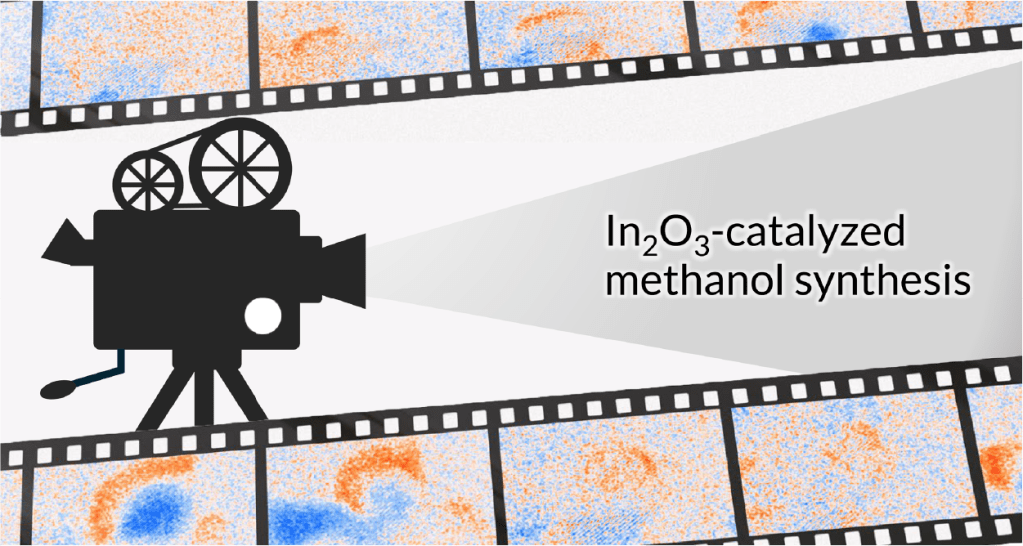
In this work, synthetic training data is generated and used to train a U-Net model to segment contrast decreases and increases arising from Indium oxide dynamics in in-situ time-series difference-images. By studying catalysts with different support material and in different gas environments, we conclude that there is a strong interaction between In2O3 and high surface area m-ZrO2, consistent with less dynamics on that support and a higher productivity for CO2 hydrogenation to methanol.
Improving Nanoparticle Size Estimation from Scanning Transmission Electron Micrographs with a Multislice Surrogate Model
Henrik Eliasson and Rolf Erni
Nano Letters
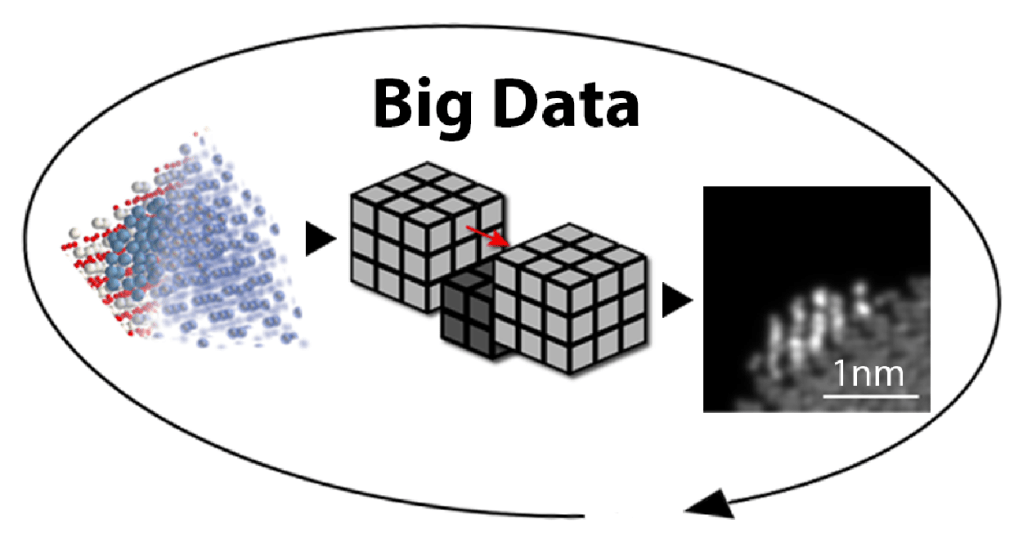
A 3D U-Net surrogate model was implemented to speed up dataset generation of physical image simulations in scanning transmission electron microscopy. The surrogate model is 1000x faster than the physical multislice algorithm for images of size 128×128 and predicted images are indistinguishable from real ones. With 100.000 new synthetic training samples, nanoparticle size estimation becomes significantly more robust and the mean size prediction error drops below 10% for particles in the 1-1000 atom range.
2024
Precise Size Determination of Supported Catalyst Nanoparticles via Generative AI and Scanning Transmission Electron Microscopy
Henrik Eliasson, Angus Lothian, Ivan Surin, Sharon Mitchell, Javier Pérez-Ramírez, and Rolf Erni
Small Methods
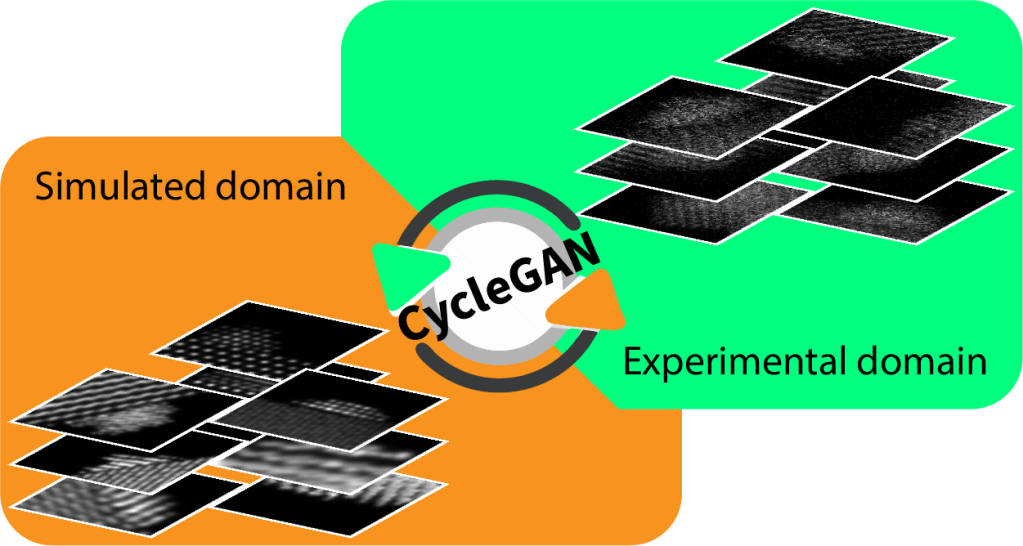
The gap between experimental and physical simulated data is bridged by a CycleGAN. By mapping simulated data to the experimental domain, we can train neural networks that directly generalize to experimental data without introducing human bias. We show that the workflow works well by training a size estimator network which predicts the number of atoms that the nanoparticle in the image consists of.
Localization and segmentation of atomic columns in supported nanoparticles for fast scanning transmission electron microscopy
Henrik Eliasson and Rolf Erni
npj Computational Materials
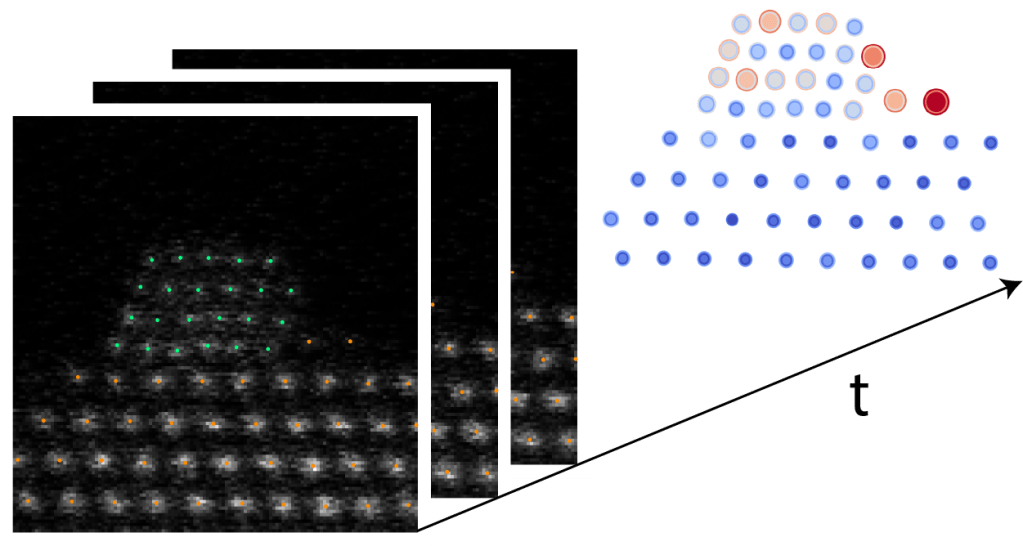
Synthetic data is generated to train a model for atomic column localization and column classification into particle or support. The model achieves picometer precision and high classification accuracy on highly noisy data acquired both in vacuum and in-situ with a gas-cell holder. By tracking individual column movements in time this model can also reveal site-specific movement patterns hinting at these sites having different properties.
